Employers are legally obligated to provide facilities that meet the standards set out in the Workplace (Health, Safety and Welfare) Regulations 1992, which are enforced by the Health and Safety Executive (HSE). These regulations are designed to protect employees' health and to make sure they can work in a safe, sanitary and comfortable environment. Meeting these requirements is part of an employer’s wider health and safety responsibilities, helping to create conditions where staff can focus on their roles without unnecessary risks.
As a leading provider of high-quality accommodation solutions, we recognise how vital it is for employers to provide adequate welfare facilities and maintain safe, well-managed sites. If an employer fails to implement these safety provisions for their workers, it can leave them open to potential legal repercussions.
Findings from a recent Bunkabin survey show that most workers believe their workplace is a safe place to work, yet there are areas where standards could be raised. Toilet facilities and staff rooms were highlighted as areas that often fall below expectations, reinforcing the need for employers to provide appropriate facilities that properly support worker welfare.
THE MAJORITY OF WORKERS FIND THEIR FACILITIES SAFE
Survey results show that most employees are satisfied with the safety and upkeep of their workplace. An impressive 91% believe their workplace provides a safe working environment, with only 6% expressing the opposite view and 3% remaining unsure. This reflects the efforts many employers make to implement sufficient safety measures, comply with regulatory standards and to create surroundings where staff feel secure carrying out their work. A strong perception of safety helps support morale and productivity, reducing concerns that could otherwise distract workers from their roles.
Alongside this, 89% of workers reported that their building is in good repair, while 11% felt otherwise. Within this group, three key issues were raised most often.
Dampness was highlighted by 18% of respondents, with concerns that it could affect both health and comfort over time. Poorly fitted windows were noted by 13%, raising risks of draughts, reduced insulation and energy inefficiency, as well as potential security issues. A further 7% pointed to uneven flooring, an issue that can create a direct risk of trips, slips and falls, which remain among the most common causes of workplace accidents.
These findings highlight the need for regular inspections and risk assessments to keep facilities well maintained and to identify areas that may present hazards. By addressing issues such as damp, damaged windows and uneven flooring, employers can provide facilities that meet workplace welfare requirements and uphold their health and safety responsibilities. Investing in these measures not only maintains compliance with legal standards but also strengthens day-to-day working conditions for staff.
MOST WORKERS FIND KEY AREAS OF THEIR WORKPLACE CLEAN
Overall, the findings reveal that the majority of respondents hold a positive view regarding the cleanliness of key areas within their workplace, highlight the efforts made by employers to maintain a sufficient sanitary conveniences and a hygienic environment.
While all areas were regarded as being clean or very clean, toilets were reportedly the cleanest area with 78% of respondents expressing satisfaction with this area. This was followed by staff rooms (77%), floors and stairways (76%) and the premises, furniture and fittings (75%).
It is worth noting that only a small percentage of participants, namely 3% for floors and stairs, and 4% for premises, furniture and fittings, toilets and the staff room, rated these areas as dirty or very dirty. While these figures are relatively low, they still serve as important feedback for employers to address areas where improvements are needed.
ALMOST HALF OF WORKERS DON'T HAVE A STAFF ROOM
ata shows that a significant portion of workers, comprising 43%, reported that they do not have access to a dedicated staff room. This finding raises concerns as staff rooms play a vital role in providing employees with a designated space for relaxation, breaks and social interactions.
On the other hand, the survey also indicated that 57% of workers do have access to a staff room. This indicates that a majority of employers understand the importance of providing such facilities to their workforce. Staff rooms offer a sanctuary within the workplace, allowing employees to recharge and rejuvenate during their breaks, fostering a positive work environment and enhancing overall job satisfaction.
The data underscores the need for employers to assess the availability and accessibility of staff rooms within their organisations. For the 43% of workers who currently lack access to a staff room, it may be beneficial for employers to consider the potential of establishing such a space. By providing employees with a dedicated area for relaxation and socialisation, employers can contribute to their wellbeing.
Most sought-after additions to staff rooms
When asked about the most sought-after additions to staff communal areas, the following answers emerged as the most popular choices:
Data shows that a significant portion of workers, comprising 43%, reported that they do not have access to a dedicated staff room. This finding raises concerns as staff rooms play a vital role in providing employees with a designated space for relaxation, breaks and social interactions.
On the other hand, the survey also indicated that 57% of workers do have access to a staff room. This indicates that a majority of employers understand the importance of providing such facilities to their workforce. Staff rooms offer a sanctuary within the workplace, allowing employees to recharge and rejuvenate during their breaks, fostering a positive work environment and enhancing overall job satisfaction.
The data underscores the need for employers to assess the availability and accessibility of staff rooms within their organisations. For the 43% of workers who currently lack access to a staff room, it may be beneficial for employers to consider the potential of establishing such a space. By providing employees with a dedicated area for relaxation and socialisation, employers can contribute to their wellbeing.
MOST SOUGHT AFTER ADDITIONS TO STAFF ROOMS
When asked about the most sought-after additions to staff communal areas, the following answers emerged as the most popular choices:
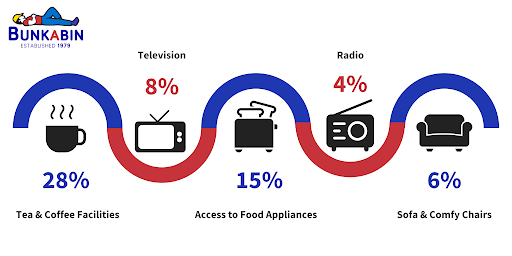
Survey responses show that staff value practical and comfortable additions to their communal areas. When asked what they would like to see included, tea and coffee making facilities came out on top, with 28% of respondents highlighting this as their first choice. A further 15% wanted access to food preparation appliances such as microwaves and toasters. These requests show the importance employees place on being able to store and prepare drinks, meals and snacks on-site, helping them make the most of their breaks while supporting a healthy work-life balance.
Comfort and entertainment were also raised as areas where improvements could be made. Six percent of workers wanted sofas or more comfortable seating, while 8% said they would like a TV in their staff room. Another 4% expressed interest in music or audio entertainment. Together, these additions provide workers with the means to relax, switch off for a short period and return to work refreshed.
By providing facilities that address these preferences, employers can create staff rooms that are more than just functional spaces - they become areas that support wellbeing, boost morale and contribute to a safe and healthy workplace.
A QUARTER OF WORKPLACES DON'T HAVE SEPARATE TOILET FACILITIES FOR MEN AND WOMEN
The survey results have revealed a concern regarding the availability of separate toilet facilities for men and women in workplaces. Alarmingly, the data indicates that 26% of surveyed workers are not provided with separate facilities for genders. This finding raises concerns regarding compliance with the Workplace (Health, Safety and Welfare) Regulations 1992, which clearly state that employers should provide welfare and toilet facilities that are a separate room for each gender.
The provision of separate toilet facilities for men and women allows privacy, dignity and hygiene in the workplace. It promotes a comfortable and inclusive environment, addressing the specific needs of each gender. By not meeting this requirement, employers may be inadvertently compromising the wellbeing and welfare of their employees.
WHAT FACILITIES DO EMPLOYERS HAVE TO PROVIDE?
Employers must provide suitable facilities that create a safe and healthy environment. This is a legal requirement and forms the foundation of workplace welfare. It s about compliance, and giving workers the conditions they need to do their jobs properly and safely.
Welfare facilities are the starting point. Every site should provide the right number of toilets and washbasins, including accessible toilets for disabled staff. An adequate supply of readily available drinking water must be on hand throughout the working day. Workers also need somewhere suitable to rest and eat meals, with facilities maintained in good order to meet daily demands.
Creating a healthy working environment requires more than basic welfare facilities. Workplaces must be clean, maintained at a reasonable temperature and enclosed workplaces must be adequately ventilated. Lighting should be suitable for the type of work being carried out, while floorspace and seating arrangements should allow staff to move and work comfortably. Together, these measures contribute to a safe and healthy environment that supports both physical well-being and productivity.
Safety depends on ongoing attention to the workplace itself. Equipment should be properly maintained, traffic routes must remain clear of obstructions and floors kept hazard-free. Windows should be easy to open and clean, supporting airflow and natural light while reducing risks linked to poor ventilation or limited visibility. These steps help to maintain a safe workplace that is fit for purpose.
In workplaces where personal protective equipment or uniforms are required, employers should also provide separate changing facilities for men and women, along with readily accessible places with washing facilities to handle hazardous materials.
First aid facilities should also be provided in all workplaces. What is considered 'adequate and appropriate' will depend on the nature of the workplace and number of staff. This includes whether trained first-aiders are required, what should be included in a first-aid box and if a first-aid room is required.
This level of provision reinforces health and safety responsibilities and helps to create a workplace that is both compliant and fit for purpose.
IS IT A LEGAL REQUIREMENT TO HAVE A STAFF ROOM?
Employers are not legally required to provide staff rooms, but offering a private space where employees can rest during breaks is strongly recommended. Having an area set aside for downtime supports workplace welfare by giving staff the chance to recharge, which in turn improves concentration, productivity and overall wellbeing. A comfortable rest space also shows a commitment to health and safety responsibilities, creating an environment where staff feel valued and supported.
Beyond a simple rest area, additional facilities can make a clear difference to day-to-day operations. Washing facilities such as shower blocks, or sleeping areas for those working long shifts or on remote projects, help staff to recover more effectively between tasks. Well-rested employees are more alert, less likely to make mistakes and less prone to accidents. This contributes to a safe and healthy workplace while reducing absenteeism linked to fatigue or poor working conditions.
For projects based in isolated areas, on-site rest facilities and welfare spaces also reduce the need for staff to travel long distances to and from work. By limiting travel time, employers can cut down on hotel costs, improve punctuality and create more efficient workflows. Portable accommodation solutions, such as sleeper cabins or communal dining areas, are practical ways to meet these needs while keeping operations flexible.
If you’re looking for an affordable, flexible way to upgrade your workplace facilities, Bunkabin has the solution. Our high-quality modular buildings, diners and shower blocks are built to support safety, welfare and productivity, giving your team the facilities they need to perform at their best. With a simple hire process and reliable nationwide delivery, we make it easy to get the right units on-site quickly. Explore our full range of modular buildings and portable units today, or get in touch with our team to find out how we can support your project.
If you're looking for an affordable, flexible option for your workplace facilities Bunkabin's quality modular buildings, diners and shower blocks support safety, welfare and productivityWe offer a straightforward hire process with reliable nationwide delivery. Explore our full range of modular buildings and portable units, or get in touch
To read about our results in further detail, you can download our full survey findings here. If you wish to utilise any part of this data for editorial purposes, please credit Bunkabin at https://www.bunkabin.co.uk.
Testimonials
We approached Bunkabin in 2015 to deliver a turnkey accommodation solution for our performers from around the world who were performing at Her Majesty The Queen’s 90th Birthday Celebrations at Windsor this year. Subsequently 200 Bunkabins were ordered and work started on the planning of such a major logistical operation. In 22 days, 200 Bunkabins, complete with bedding kits, were delivered and installed and when our performers arrived they were amazed that we could offer an on-site solution that offered everything they needed. It made for a real village atmosphere with all nations joining together and we couldn’t have asked for more.
Bunkabins drivers were amazing – taking great care when loading and offloading not to damage the grass in the Private Grounds of Her Majesty The Queen and all in all the Bunkabins worked perfectly
Nick Brooks-Ward, H Power Group - Event Planning Services
Over the last 6 years we have increased the Student Village from initially 30 up to currently 274 en-suite Student Sleepers. The Student Village Company provide us with a flexible accommodation capacity, so as long as we have land available, we no longer need to turn away a student because of accommodation shortages.
It is very difficult to predict exact intake numbers however The Student Village Company are able to provide additional capacity only a few weeks before freshers week. The decking, canopy and decals make an enormous difference. The students love them.
While Bunkabins aren’t complicated... There will undoutedly be a raft of questions you will need answering. So with this in mind, we have compiled a list of the most frequently asked ones and, handily, provided the answers to boot.
The aim was to find an accommodation solution that could be deployed quickly and safely, while exceeding industry standards of electrical, fire and structural safety and providing a comfortable living…
As a successful agricultural business, Valley Produce depends heavily on having the right onsite accommodation solutions in place for its seasonal workers. Bunkabin has been able to provide those…
How do you solve an issue of having more students arriving than you have available accommodation? Bunkabin works with Reaseheath College to support them as they expand,enabling them to grow their…
The Royal Navy found themselves requiring 302 more bed than they had available. Rather than costly and time-consuming building work being initiated an alternative tempory solution was sort and…
Her Majesty’s 90th Birthday Party was a celebration of The Queen’s life and involved more than 1,500 participants from around the United Kingdom and the World. It focused on her love of horses, her…
Bunkabin has long had a great working relationship with Glastonbury Festival. Our sleepers and shower blocks offer their management, staff and the supply personnel the comfortable environment they…