HOW TO SET UP CONSTRUCTION SITE PERIMETER PROTECTION
benrothwell
Aug 16th, 2023
Setting up construction site perimeter protection is a legal requirement in the UK under the Health and Safety at Work Act 1974 and the Construction (Design and Management) Regulations (CDM) 2015. A secure perimeter ensures worker safety, prevents unauthorised vehicle access, and protects the public. It also reduces the risks and liabilities linked to construction work. This guide outlines how to set up a compliant perimeter in line with UK health and safety regulations, local laws and industry best practice.
CHECK THAT YOU HAVE PERMISSION
Before installing any construction site security fencing or barriers, you must secure the right permissions. Failure to do so can delay projects or result in enforcement action.
Planning permission: consult your Local Planning Authority to confirm what approvals are needed.
Risk assessments: under CDM 2015, a thorough risk assessment is mandatory to identify hazards.
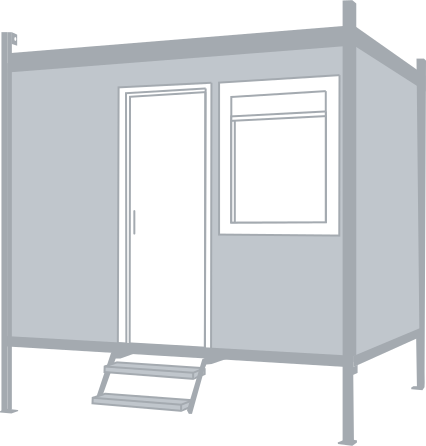
It’s important to note that CDM 15 also requires that you provide access to welfare facilities, including toilets, washing areas and rest accommodation. Portable cabins, such as Bunkabin’s Site Sleepers and hygiene units, are often the most cost-effective and compliant solution.
Understanding the legal requirements
Construction sites must operate within strict legislation:
Listed building consent is required if the site affects a listed building.
Environmental Impact Assessments may be necessary where construction has wider environmental implications.
Other approvals may include Tree Preservation Orders, conservation area consent or highway access permits.
Once permission is granted, ongoing compliance is required. Site managers must regularly review conditions and consult authorities if plans change. All hazards in the area must be identified through conducting a thorough risk assessment, and you will need to provide your workers with amenities to ensure their health and welfare needs are met. Failing to fulfil any of these key points in your construction project will lead to unlawful conduct.
CONSTRUCTION SITE ASSESSMENT
The first stage in planning perimeter security is a full site analysis. Consider:
Terrain: slopes, channels or uneven ground can complicate fence placement.
Potential hazards: weak structures or unstable soil may affect perimeter security systems.
Accessibility: decide where vehicles and workers will enter and how to set up access control points.
Neighbouring properties: assess noise, space restrictions, and boundaries.
Environmental factors: weather exposure, flooding risks, or high winds may require reinforced barriers.
PLANNING CONSTRUCTION SITE SECURITY
Before you can install any security fencing or walls, you must first know what types of walling or fencing you will need, how many units you will need, and where they will actually go. Without proper planning, you may spend more time and finances getting the fencing or walls than is necessary, and you may not meet your requirements.
Define the boundaries
Using site maps and surveyors, establish site boundaries with stakes or markers. Communicate these boundaries to contractors and your security team to avoid accidental breaches.
Selecting materials
Choosing the right materials depends on budget, location and project scope. Options include:
Concrete barriers: heavy-duty, stable, and effective for both traffic control and perimeter protection.
Steel fencing: high-strength and suitable for urban areas or areas where there is a higher risk of security threats.
Mesh fencing: flexible and cost-effective for temporary use.
Wooden hoarding: provides privacy, reduces noise and blends into residential environments.
IMPLEMENTING PERIMETER SECURITY SYSTEMS
Adhering to health and safety rules is essential in any type of project. This applies to site access and perimeter management, too, and a well-planned and built perimeter can help to reduce some of the risks that construction workers may be subject to.
Safety barriers
There are various types of safety barriers, each serving a specific purpose. Temporary barriers can be used to control pedestrian or vehicular traffic access points while more permanent solutions are better suited to securing the site against unauthorised access. It is also important to remember that safety barriers are not just about construction site security, but about guiding and protecting everyone on and around the site.
Signage and lighting
Under the Health and Safety (Safety Signs and Signals) Regulations 1996, construction sites must display clear signage to indicate warnings, hazards and directions. This is essential for keeping workers and visitors informed and protected. Lighting also plays a key role - adequate illumination improves safety for workers in low-light conditions, supports security patrols and helps to deter unauthorised access to the site.
Access control and security solutions
Modern construction industry standards increasingly rely on electronic security solutions. Options include:
Controlled entry gates with card readers or PIN access.
CCTV monitoring for 24/7 visibility.
On-site security cabins for guards, integrated with welfare facilities.
Monitoring and maintenance
Even with a strong initial plan, things can change and go wrong throughout a construction project. You must make sure to monitor the condition of the perimeter and ensure that the workers uphold the rules around entering and exiting the site. If something breaks or seems to not be working you should take steps to remedy it.
Regular inspection
Regular inspections of the perimeter should be performed at regular intervals. This involves checking that barriers are intact, signs are legible, and lighting is functioning. A consistent routine, possibly daily or weekly depending on the nature of the site, will help you identify and address issues before they escalate.
Maintenance
Maintenance of the perimeter is not a one-time task but requires continuous attention. Regular adjustments or repairs may be necessary based on wear and tear or changes in site conditions. Having a clear set of maintenance protocols, along with a designated team or individual responsible for this task, ensures that your perimeter remains robust and compliant at all times.
MEETING YOUR WORKERS' NEEDS
As well as requiring a sturdy perimeter, further steps must be taken to manage the space you have within the site. Portable accommodation can help with this due to its adaptability and ease of installation. Bunkabin prefabricates our portable accommodation units before shipping them. We then install them directly onto sites in the configuration required by site managers. This, combined with the fact we supply a range of different-sized Site Sleepers, means that you can easily plan your accommodation needs within the constraints of your perimeter.
To learn more about how Bunkabin can help you, call us today on 0345 456 7899, or fill out an online contact form and we will return your call at a time suitable for you.
Testimonials
We approached Bunkabin in 2015 to deliver a turnkey accommodation solution for our performers from around the world who were performing at Her Majesty The Queen’s 90th Birthday Celebrations at Windsor this year. Subsequently 200 Bunkabins were ordered and work started on the planning of such a major logistical operation. In 22 days, 200 Bunkabins, complete with bedding kits, were delivered and installed and when our performers arrived they were amazed that we could offer an on-site solution that offered everything they needed. It made for a real village atmosphere with all nations joining together and we couldn’t have asked for more.
Bunkabins drivers were amazing – taking great care when loading and offloading not to damage the grass in the Private Grounds of Her Majesty The Queen and all in all the Bunkabins worked perfectly
Nick Brooks-Ward, H Power Group - Event Planning Services
Over the last 6 years we have increased the Student Village from initially 30 up to currently 274 en-suite Student Sleepers. The Student Village Company provide us with a flexible accommodation capacity, so as long as we have land available, we no longer need to turn away a student because of accommodation shortages.
It is very difficult to predict exact intake numbers however The Student Village Company are able to provide additional capacity only a few weeks before freshers week. The decking, canopy and decals make an enormous difference. The students love them.
While Bunkabins aren’t complicated... There will undoutedly be a raft of questions you will need answering. So with this in mind, we have compiled a list of the most frequently asked ones and, handily, provided the answers to boot.
The aim was to find an accommodation solution that could be deployed quickly and safely, while exceeding industry standards of electrical, fire and structural safety and providing a comfortable living…
As a successful agricultural business, Valley Produce depends heavily on having the right onsite accommodation solutions in place for its seasonal workers. Bunkabin has been able to provide those…
How do you solve an issue of having more students arriving than you have available accommodation? Bunkabin works with Reaseheath College to support them as they expand,enabling them to grow their…
The Royal Navy found themselves requiring 302 more bed than they had available. Rather than costly and time-consuming building work being initiated an alternative tempory solution was sort and…
Her Majesty’s 90th Birthday Party was a celebration of The Queen’s life and involved more than 1,500 participants from around the United Kingdom and the World. It focused on her love of horses, her…
Bunkabin has long had a great working relationship with Glastonbury Festival. Our sleepers and shower blocks offer their management, staff and the supply personnel the comfortable environment they…